Forklift Rental Service
Forklift is a small industrial vehicle, having a power operated forked platform attached at the front that can be raised and lowered for insertion under a cargo to lift or move it. Forklifts serve the needs of various industries including warehouses and other large storage facilities.
Forklifts are powered by electric battery or LPG engines. Some
Forklifts allow the operators to sit while driving and operating the machine
while others require the operator to stand. It is being extensively used
throughout the industry for transporting materials and goods.
Forklift consists of
variety of components required to handle the task effectively. From Truck
Frame, power source to counterweight are essential for the forklift to
function efficiently.
Forklift - Truck Frame
Truck Frame is the most vital
component which forms the base of the machine. All of the key components of the
forklift including wheels, counterweight and mast are attached to the truck
frame.
Forklift – Counter weight
The Counterweight is a cast iron
weight attached to the rear part of the forklift. The aim of the counterweight
is to counter balance the load that is being lifted. On Electric Forklift,
Counterweight is fixed to the lead-acid battery.
Forklift - Power Source
The forklift’s power source consists
of an internal combustion engine. The engine can be fueled by LPG, CNG, diesel
and natural gas. Electric Forklifts derive power from fuel cells or Lead Acid
Batteries.
Forklift - Mast
The Mast is a vertical part that lifts up and pushes down the loads. The Mast component consists of Joining Supports that offers horizontal control. Like Carriage, Mast may be equipped with rollers.
SendhamaraiEngineering are authorised dealer of Hyundai Forklift – material handling
equipment & Forklift rental services in different locations in India. Our
services in Chennai, Bangalore, Ahmedabad, pune, Hyderabad, anantapur, Delhi.
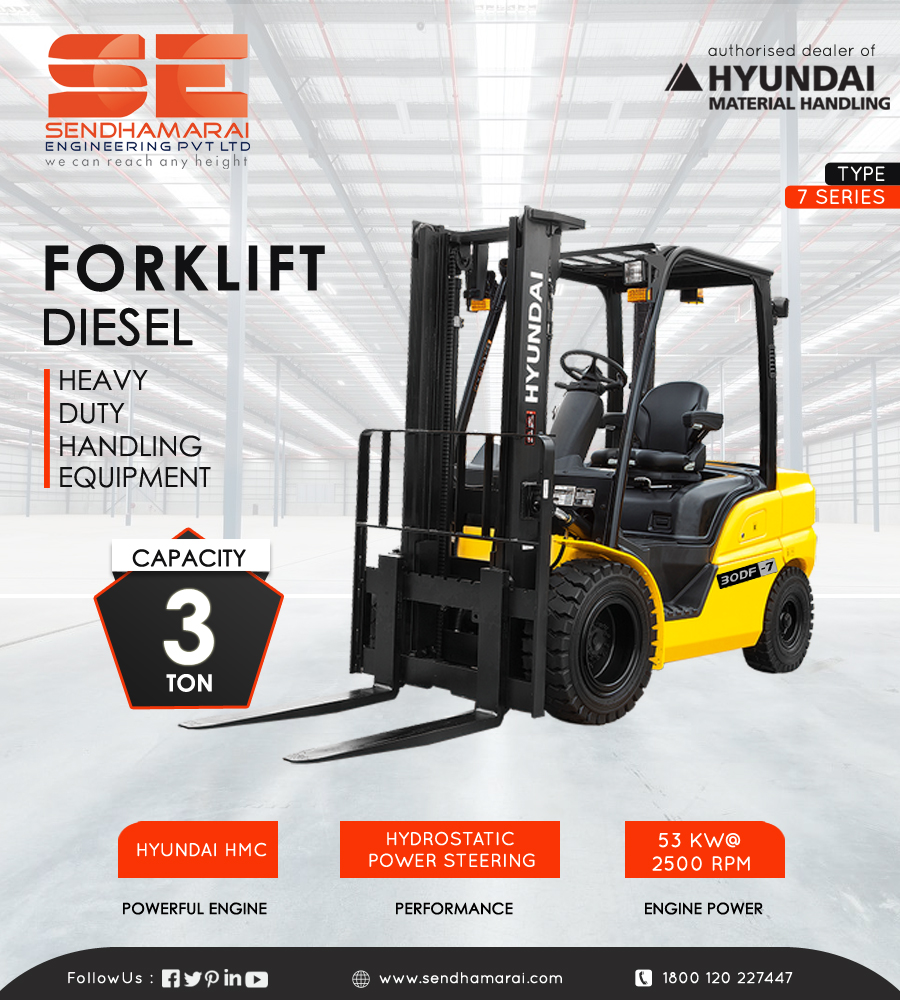
How a Forklift Works?
- A Pair Of Hydraulic Cylinders
- A Pair Of Roller Chain Pulleys
- Controls
Forklift Machine - Hydraulic Cylinders
The lift handle is attached to an
electrical air pump at the base of the forklift. Once the handle is pressed, it
triggers the air pump that draws the outside air through a filter and forces it
into a tube reaching to the hydraulic cylinders.
A hydraulic cylinder comprise of a
hollow tube closed at one end with a flexible lubricated piston fitting into
the other. Air gets entrapped through the base of the cylinder that allows
gasses to enter without leaking them out.
The volume of gas in the cylinder
raises the pressure inside it. The pressure applied to the area of the piston
head generates an upward force. This force causes the piston to move up,
increasing the volume of the gas and minimizing the pressure. It creates
physical equilibrium at the forklift height and an equivalent force from the
Gas and the Forklift’s Load.
Forklift Machine - Roller Chain Pulley
The hydraulic pistons are attached to
the two main vertical structures known as “masts”. Forks that are meant to
carry the load are attached to the main body of the forklift by a pair of
roller chain pulleys whose fulcrum forms a gear at the top of the mast.
Hence, when the hydraulic pistons
push the masts in upward direction, the gears on the masts is pressed against
the roller chains. It happens because the one side of the chain is fixed to the
immovable frame of the forklift, and the only way by which masts can move
upward is when gears rotate in clockwise direction and pull the forks overhead.
The significance of this mechanism is
that it let the forks go far away from the reach of the cylinders. If it is not
meant for roller chain pulleys then forklifts would require much taller
cylinders to lift up the load to an equivalent height.
Forklift Machine - Steering
Control
Forklifts use rear
wheel steering. When you turn on the steering wheel, the wheel at the rear axle
starts to turn back and forth. This is intentionally designed to allow operator
to take greater degree of rotation and precision while handling a cargo.
Lifting Control
The Lifting Control comprises two
levers: One for Lifting the Fork up & down and Other For Tilting the Load
Back & Forth.
Lifting Control work same as lifting
mechanism discussed above. The Tilting Mechanism is somewhat different. There
are two pairs of additional hydraulic cylinders attached to the base of the
masts.
Once the Tilt Handle is moved in
forward direction, the air automatically fills up the chamber. The rise in
pressure is enough to push the head of the piston and let the masts go away
from the vehicle’s body.
Once the Tilt Handle is moved back,
the air gently passes away from the cylinder and get pumped to other part of
the mast-attached cylinders. When the pistons are pushed forward, the masts are
pushed back to the vehicle.
For More details contact @ 1800 120
227447 | info@sendhamarai.com |
www.sendhamarai.com

No comments:
Post a Comment